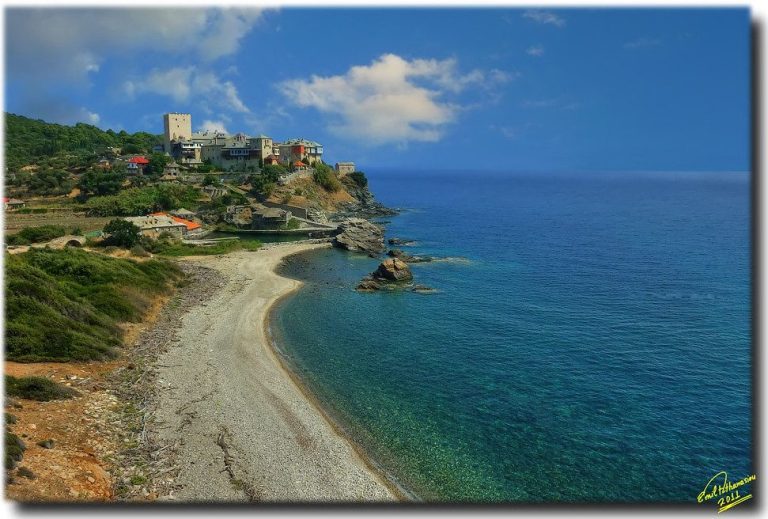

Xiropotamou Monastery
If you’re staying in Ouranoupoli, Mount Athos is right next door. If you want a monastery that’s easy to reach from Dafni but immediately conveys the weight of history and faith, Xiropotamou is one of the strongest choices.
I often recommend it to visitors who come for pilgrimage and don’t want to “lose” a day on long transfers. It’s close, sits in a panoramic spot, and holds a relic few have the chance to see up close.
The Keeper of the Holy Wood
Xiropotamou Monastery is one of Mount Athos’s most historic monasteries and is especially important because it guards the largest fragment of the Holy Wood (the True Cross relic) in the world. For many pilgrims that is the main reason to visit. For others it’s the feeling of the place: the calm, the view over the Sigitikos Gulf and across to Sithonia, especially on clear days when the light falls softly on the sea.
Geographically, the monastery sits on the western side of the Athos peninsula, which makes it very convenient for those entering from Ouranoupoli. From Dafni, the main port of Mount Athos, the distance is short and practically allows you to begin your pilgrimage smoothly without spending the whole day on the road.
Centuries of history and tradition
Xiropotamou is considered one of the oldest monasteries on Athos. By tradition it was founded in the 5th century by Empress Pulcheria, while its historical presence is attested from the 10th century by Saint Paul of Xiropotamou. In the hierarchy of the monasteries it holds the 8th position, which reflects its importance in the Athonite system and its long historical path.
Like many monasteries, it went through hard times: fires, lootings, and unrest. Yet it recovered, supported by Byzantine emperors and later by rulers of Wallachia. Those “rebirths” are visible in the way it is built and organized. It is not only a spiritual place; it’s also a community that learned to protect itself, survive, and continue.
Location, architecture and an unforgettable view
The monastery is built on a hill. From up there, especially when a light north breeze blows, your view opens toward the Sigitikos Gulf and, on clear days, you can clearly make out Sithonia. It’s one of those views that make you fall silent without realizing it. Just before sunset the light turns golden and the landscape looks like a painting.
At the center of the monastery’s life is the Katholikon. Built in 1761, it is dedicated to the 40 Martyrs. It’s spacious, with an impressive iconostasis and frescoes worth observing in silence. Don’t rush. Even if you’re not a regular churchgoer, you’ll sense the work, effort and reverence the space carries.
In the courtyard the Phiale stands out. Considered one of the most elegant on Mount Athos, it’s a marble basin from 1783. Around it, the defensive layout with its tower recalls other times, when raids by Latins and pirates were not just book history but a real fear. These details fit beautifully with the landscape: hard stone, soft light, and a feeling of safety.
Holy relics and the library
The monastery’s most precious relic is, of course, the Holy Wood. It is the largest fragment of the Holy Wood in the world and, it is said, bears one of the nail holes from the Crucifixion. For many people, the moment they see it is deeply personal. Some are moved to tears, others stand still. It’s best to go with respect, without haste, and follow the monks’ instructions.
The monastery also keeps the Pulcheria disk, a rare steatite work of art, as well as relics of the 40 Martyrs, Saint Ignatius the God-bearer and many others. If you’re interested in manuscripts and old books, the library holds about 400 manuscripts and over 4,000 printed volumes. Many are rare editions. This is not a museum with glass cases like in the cities. It’s a living part of a community that continues to this day.
For a general overview of Mount Athos’s status and history, a look here helps: Mount Athos — Wikipedia. For a more official view of the area and the destination, see the Municipality of Aristotelis.
Major feasts and what to expect
Xiropotamou follows the Julian (Old) Calendar. That confuses many visitors, especially the first time. If you plan to attend a feast day, ask early and confirm dates with official sources, because hosting details and visitor flows change.
The main feasts to note are those of the 40 Martyrs, the monastery’s primary celebration, on March 9 (New Calendar) and March 22 (Old Calendar). Also the Exaltation of the Holy Cross on September 14 (New) and September 27 (Old), when the Holy Wood is displayed with particular solemnity. On those days the atmosphere is busier, with more pilgrims and a livelier rhythm. If you prefer quiet, choose a regular weekday. If you want to experience the feast, be prepared for patience and a good spirit.
How to get there from Ouranoupoli and why it’s so convenient
From Ouranoupoli you take the regular boat line to Mount Athos and disembark at Dafni. I never give fixed schedules because they change with the season, weather and port needs. It’s better to confirm with the relevant services. For sea weather, especially when there’s a northerly wind, it’s worth checking the official forecast: Hellenic National Meteorological Service.
From Dafni to the monastery you have two practical options. The first is a hike of about 20–30 minutes on an uphill but manageable path and road. You’ll need sturdy shoes and some water, especially on a hot day. The second is the buses that run from Dafni to Karyes. They stop at the entrance to Xiropotamou Monastery and the ride is about 5 minutes. It’s ideal if you have limited time or don’t feel comfortable walking.
As someone who hosts guests here for years, I’ll say it plainly: as a first step into Mount Athos, it’s one of the most “human” options. It won’t exhaust or stress you, and it leaves time to settle into the atmosphere.
What to do there and small practical tips
A visit is not a “sight” in the usual sense. It’s an experience. Move calmly, speak softly, give space to other pilgrims, and follow the monks’ directions. If you have the chance to stay overnight, you’ll feel the monastery’s daily rhythm. Hours are fixed, the pace is steady, and silence at night has a different quality. Some guests tell me they slept deeply and rested; others say they woke very early without feeling tired. It’s that odd thing that changes your body and mind.
To make your day go smoothly, keep a few simple things in mind:
- Wear closed, comfortable shoes. The uphill from Dafni is short, but you’ll notice it if the path is slippery or it’s hot.
- Bring a light jacket, even in spring or fall. The hill catches wind, and inside the churches the temperature drops.
- Don’t rely on your phone. In some spots the signal cuts out, and honestly it’s better that way.
- If you want to see the Holy Wood, ask respectfully. The monks usually help, but it’s not a duty to display it at every moment.
If you travel in summer, expect more heat near Dafni and more traffic on the boats. In spring and autumn visibility is often better, walking is more pleasant and the colors of the landscape are clearer. In winter things are quieter, but the weather can stop movements. Be cautious and confirm plans; don’t take it lightly.
Who it suits best
I recommend Xiropotamou Monastery to pilgrims entering Mount Athos for the first time who want something close to Dafni. It’s also suitable for older visitors who don’t want long hikes but want to feel a historic monastery with important relics. It’s a good fit for those interested in architecture and monastic fortification—the layout and the tower say a lot without many words.
If you love long walks on trails, you can make Xiropotamou your first stop and continue toward Karyes and other monasteries. If you have only a few days, Xiropotamou gives you a dense experience within a short distance. That’s its strong suit, and those who’ve done it know it well.
Permits, accommodation voucher and small local tips
To enter Mount Athos you need a permit (diamonitirio). That’s the first thing you arrange, before anything else. In Ouranoupoli you’ll find the Pilgrims’ Office, and it’s good to have the necessary documents ready and be on time, because on busy days queues and delays occur. One small tip: don’t leave it to the last minute. Every year I see people arrive anxious and spoil the mood of the first day.
If you need practical help, these are the useful phone numbers we often give:
- Ιερά Μονή Ξηροποτάμου: +30 23770 23251
- Pilgrims’ Office (Ouranoupoli): +30 23770 71421
- Ouranoupoli Port Authority: +30 23770 71248
- Athos Guest House – Pansion: +302377071337, +306957638384
If you like, we can help with the basics of preparing before entry, especially if it’s your first time.
Contact us
to see the availability or offers for your stay.
send us an email to info@pansionathos.gr
call us: +306957638384 or +302377071337
call us or send a message via WhatsApp
send an SMS text message
call us or text us on Viber
Don’t forget to mention:
- Number of Persons, Possible Dates, Requirements
A suggested 4–5 day route that ties together nicely
Many guests staying with us choose a program that starts gently, with the first night at Xiropotamou. We jokingly call it “the route of the Holy Wood,” because the experience around the Holy Wood gives a special tone from the start. After that you can continue to Karyes for the Protaton and visit other monasteries depending on your stamina and time. You don’t need to try to see everything. Better a few meaningful stops than many rushed ones—otherwise it all becomes confusing.
If you’re short on time, Xiropotamou is ideal because it gives you room to adapt. And if you want to book accommodation in Ouranoupoli before or after your pilgrimage to rest, we’re here.
Contact us for 2026 offers and family/group discounts.
Tip from Athos Guest House – Pansion: Because of its proximity to Dafni, Xiropotamou Monastery is the ideal choice for those with limited time or difficulty on long hikes. Don’t forget to ask the monks to show you the Holy Wood!
If you want to organize your stay in Ouranoupoli before the pilgrimage or after your return, Contact us. We’ll also tell you a couple of practical things that aren’t written down easily, like when the sea usually gets windy and how to leave Dafni more comfortably without stress.