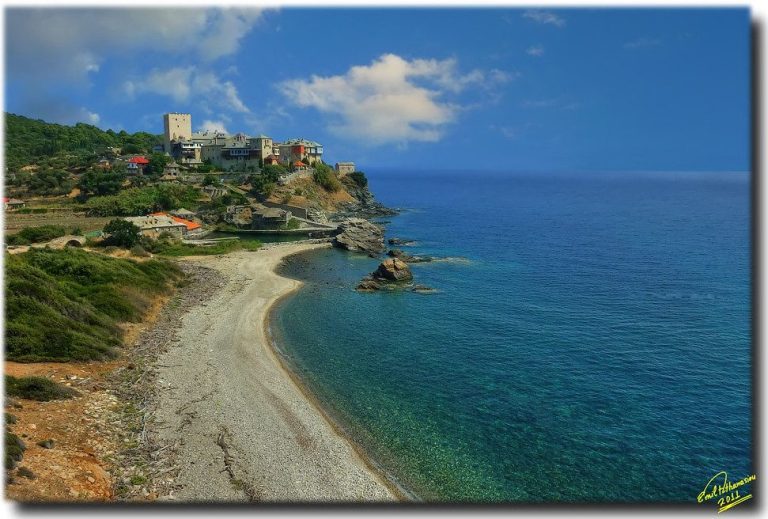

Vatopedi Monastery — Visiting from Ouranoupoli
If you’re staying in Ouranoupoli, it’s natural to feel that Mount Athos is right next door. Vatopedi Monastery is one of those visits that stays with you — not only for faith, but also for the weight of history it carries.
Here, as hosts who welcome pilgrims for years, we see the same thing every season: when preparation is right, the trip goes smoothly. When it’s rushed, stress starts at the port.
What to expect at Vatopedi Monastery and how to organize it from Ouranoupoli
Where it is and why it’s called the “royal monastery”
The Holy Great Vatopedi Monastery sits on the northeastern side of Mount Athos, in the area many call the “north side” of Athos. It’s not one of the monasteries you spot easily from the boat, as with some parts of the coast. It requires a combination of transport and a bit of patience.
It’s called the “royal monastery” for good reason. The scale of the complex, its place in the hierarchy, the wealth of its relics and its influence through the centuries make it truly a spiritual and cultural stronghold.
History and tradition that connect to today
The monastery was founded in the second half of the 10th century, around 972–985, by three nobles from Adrianople: Athanasios, Nikolaos and Antonios. In the hierarchy of the 20 monasteries it holds the 2nd rank, which already says a lot about its importance.
Its name, as the elders tell it, has a story pilgrims always listen to carefully. Tradition speaks of the rescue of the son of the Emperor Theodosius, who after a shipwreck was found safe inside a thornbush. From that comes the name “vatоs” (thornbush) and “paidion” (child).
Over the centuries the monastery was a spiritual center for important figures like Saint Gregory Palamas and Saint Maximos the Greek. What’s interesting is that beyond the history there’s a modern spiritual revival too. You feel it in how hospitality is run, the care of the spaces and the flow of pilgrims. Some days are quiet, others are busy and require patience — otherwise the mood sours.
Architecture: a small Byzantine town within walls
The first impression is the high walls and the feeling that you’re entering an organized settlement. It’s not just “a monastery.” It’s a huge complex, with courtyards, passages, chapels and buildings from different periods that nevertheless form a cohesive whole.
The Katholikon (main church) is dedicated to the Annunciation of the Theotokos and is among the oldest and most magnificent churches on Mount Athos. There you’ll see unique mosaics from the 11th and 14th centuries. Even if you’re not an art expert, you’ll pause. These are the kind of sights you don’t forget easily.
The bell tower, built in 1427, stands out as the oldest on Mount Athos. Many photograph it with their eyes rather than cameras, because inside the precincts it’s not always appropriate to take pictures. The domes, with secondary domes around the Katholikon, form a silhouette that reminds you of Constantinople. On a clear day, the light on the stone makes the whole scene feel calmer and weightier in the best way.
Holy relics and the library: Athos’s treasure
Vatopedi is considered one of the richest monasteries on Mount Athos in terms of relics. The most important relic is the Holy Belt (Agia Zoni), the only surviving relic connected in tradition to the earthly life of the Theotokos. For many pilgrims, this is the main reason for the trip.
The monastery also houses seven miraculous icons of the Virgin Mary — commonly referred to by their Greek names (Paramythia, Vimatárissa, Pantanassa, Elaiovrytissa, Pyrovolitissa, Sfagmeni and Antiphonitria). If it’s your first visit to Athos, go calmly and allow time. Don’t treat it like a checklist to rush through.
The library is another chapter. We’re talking about one of the most important libraries in the world, with over 2,000 manuscripts, many on parchment, and roughly 40,000 printed works. Ptolemy’s famed “Geography” is referenced there. These things aren’t for a quick glance — they require respect, time and proper guidance from the monastery staff, depending on what’s allowed on the day you visit.
Major feasts and the calendar: know what applies
The monastery follows the Julian (Old) Calendar. This confuses many, especially when they’re arranging days off. The two major feasts that draw larger crowds are:
- Annunciation of the Theotokos (main feast): March 25 on the New Calendar, April 7 on the Old.
- Holy Belt (Honorable Deposit): August 31 on the New Calendar, September 13 on the Old.
If you plan to travel near a feast, book accommodation very early. Also keep in mind that weather, especially in late August and September, can change abruptly. In our area the meltemi wind some days can stir up the sea and affect schedules. Before you set out, it’s worth checking an official forecast like meteo.gr to know what to expect.
Access from Ouranoupoli: the usual route that works
Ouranoupoli is the ideal antechamber. This is where the port is, where the Pilgrim Office is, and where people gather before entering the Holy Mountain. The most common route to Vatopedi is combined transport.
You start from Ouranoupoli port by boat to Dafni. From there you take a bus to Karyes and then a local bus or taxi to Vatopedi Monastery. The theory is simple, but in practice you need correct timing between connections, because when there are many people boarding and disembarking, delays happen.
There’s also an alternative via Ierissos from the northern side, depending on weather and fast-boat schedules. It’s not always the best option, but some days it can save the situation. It’s wise to discuss this with the Pilgrim Office rather than decide it last minute on the spot.
For general information about the peninsula and the status of Mount Athos, it helps to check the official regional page: pkm.gov.gr. And for a basic historical overview without exaggeration, there’s the Wikipedia entry on Vatopedi Monastery.
Practical preparation from Athos Guest House – Pansion
My usual advice to guests is simple: don’t try to do it as a same-day trip from Thessaloniki. You’ll arrive tired, rush through paperwork, and if something goes wrong with the sea or transfers you’ll be left disappointed. One overnight in Ouranoupoli the day before makes all the difference.
At Athos Guest House – Pansion we help you organize the basics so you’re rested and can start early. Our advice is to have your pilgrim permit in hand before you go to the port, so you can catch the first morning boat — usually around 06:30 or 09:45. Schedules change, so always confirm with official sources and the Pilgrim Office. Don’t rely on hearsay.
Contact us for 2026 offers and family/group discounts.
Small details that save hassle: carry water, a small snack and comfortable shoes. Not because you’ll hike long distances, but because on Athos you walk more than you think, often on stone and up slopes. Also keep some cash. In certain spots a card won’t help, and it’s stressful to be caught out over small things.
When to go: seasons, crowds and the sea
Spring and autumn are, for me, the most humane seasons. April and May bring greenery, clear air and less heat. September and October have milder weather but can be windy. Summer has more people, hotter transfers and longer waits. Especially in July and August, if you haven’t booked months in advance, finding accommodation is difficult.
One thing people don’t always think about: in Ouranoupoli, before or after the pilgrimage, the sea is often crystal clear, especially when the wind dies down. Many take a quiet swim to finish the trip nicely. Just don’t overdo the sun if you have an early start the next day — you’ll feel it on the boat, I’ve seen it many times, and it’s a shame.
Who this visit suits most
Vatopedi suits pilgrims who want to see something living and substantial, not just historical. It also fits people who love Byzantine art and manuscripts, provided they have patience and respect for the rules. For older visitors it’s absolutely possible, as long as transport is organized well and you avoid too many transfers in a single day.
For groups, agree on the pace beforehand. One person may want to linger in the Katholikon, another to move on. If you don’t sort that out, moods can be spoiled. And for first-time visitors, remember that Mount Athos is not a casual excursion — it’s an experience with rules, schedules and a need for quiet. The simpler you keep your approach, the better your visit will be.
Useful phone numbers so you don’t search at the last minute
Save these in your phone. On departure day — especially if it’s windy or busy — a phone call can save you hours.
- Vatopedi Monastery: +30 23770 41488 (Center) / +30 23770 23219
- Pilgrim Office (Ouranoupoli): +30 23770 71421
- Karyes Taxi: +30 23770 23266
- Athos Guest House – Pansion: +302377071337, +306957638384
Contact us
to see the availability or offers for your stay.
send us an email to info@pansionathos.gr
call us: +306957638384 or +302377071337
call us or send a message via WhatsApp
send an SMS text message
call us or text us on Viber
Don’t forget to mention:
- Number of Persons, Possible Dates, Requirements
Suggested 4–5 day itinerary for the northern side
The Spiritual Journey on the Northern Side
Day 1
Arrival at Athos Guest House – Pansion. Check in, review documents, rest. If you arrive early, take a walk to the Ouranoupoli Tower to clear your head. Don’t overdo late nights — you’ll start early the next day, so save your energy.
Day 2
Entry to the Holy Mountain. Transfer to Vatopedi Monastery and venerate the Holy Belt. Don’t cram too much into this day. Allow time to stand, be calm and follow the monastery’s rhythm. If you rush, it will all feel like a passing-through experience.
Day 3
Transfer to Pantokrator Monastery or to the Skete of Prophet Elijah (the Russian skete). The choice depends on where you arranged accommodation and what transfers are convenient. Don’t hesitate to ask — distances on the map don’t always tell the truth, especially if a bus change is needed.
Day 4
Transfer to Karyes. Venerate the “Axion Esti” and visit Kutloumousiou Monastery. Karyes is where you feel the pulse of the monastic community. It’s busy and lively in its own way. Go with calm and allow extra time, because waits can occur.
Day 5
Return to Ouranoupoli. If you can, stay one more night at Athos Guest House – Pansion. It’s nice to decompress before heading to Thessaloniki or your next destination. Some leave straight away and later say they didn’t have time to understand what they experienced. With a quiet night, the trip ties together better, trust me.
One last very practical tip
Due to the high demand for Vatopedi, it’s essential to have your accommodation confirmed many months in advance. Don’t leave it to “we’ll see.” Sometimes “we’ll see” becomes “it’s not possible.”
Contact the Athos Guest House – Pansion for your stay.
Contact us for 2026 offers and family/group discounts.