
Romanian Skete of St. John the Forerunner (Mount Athos)
If you come to Ouranoupolis for pilgrimage, some names are spoken in a whisper, with respect. The Romanian Skete of the Honorable Forerunner is one of them. It’s the kind of place you don’t just “see” — you feel it, especially when you descend toward Vigla and the Aegean opens up before you.
As someone working in hospitality here in Halkidiki, I’ve helped many pilgrims organize this route correctly. It takes patience, good preparation and a bit of realism, because the distance and the terrain of Athos are no joke.
Holy Skete of the Honorable Forerunner (Romanian): A Spiritual Treasure on the Edge of Athos
Where it is and why it’s called “Romanian”
The Skete of the Honorable Forerunner sits on the southeastern tip of the Athos peninsula, in the Vigla area, between the Megisti Lavra Monastery and Kavsokalyvia. Geographically it’s one of the more remote spots to visit, especially if you start from Dafni and Karyes.
It’s called Romanian because it’s the only Romanian monastic community on Mount Athos with the status of a skete, and it is administratively and spiritually under Megisti Lavra Monastery. The language, the chant style and the hospitality have a strong Romanian character, without losing the strict Athonite spirit.
For basic information about the status and history of Mount Athos, it’s worth checking the official portal of the Athonite State: https://www.agioritikipoliteia.gr/. For general context, the Wikipedia page on Mount Athos is also useful: https://el.wikipedia.org/wiki/%CE%86%CE%B3%CE%B9%CE%BF%CE%BD_%CE%8C%CF%81%CE%BF%CF%82.
A bit of history — enough to grasp the place’s weight
Romanian monks have been in the area since long ago, as early as the 14th century. The skete’s official founding, however, is dated to 1820. Later, in 1852, monks Niphon and Nektarios bought the cell of the Honorable Forerunner and a major rebuilding began, supported by the principalities of Moldavia and Wallachia.
In 1856, by a sigillion of Patriarch Cyril VII, the community was officially recognized as a skete. Since then it has preserved its distinct tradition in language and music, always under the spiritual umbrella of Megisti Lavra. These elements are not “details.” You understand them when you attend a service and hear the chanting — it’s different, deeper, more internal.
Architecture that feels like a monastery, not just a skete
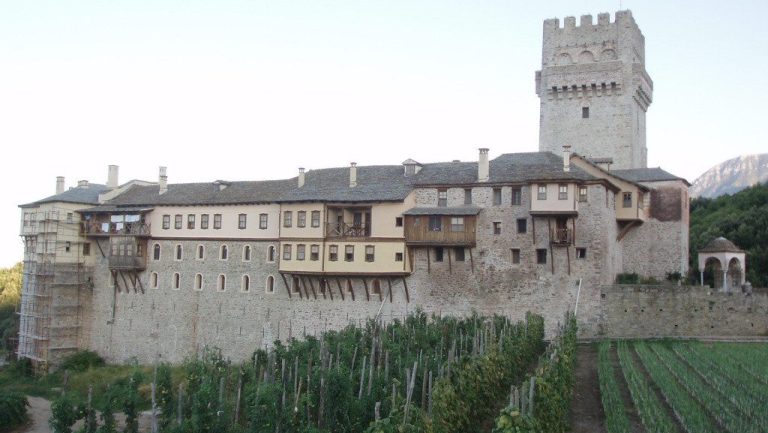
Although it’s called a skete, the complex looks like a large monastery. It’s quadrangular, imposing, and stands above the sea like a fortress. There at Vigla the winds get strong and the construction is truly robust. On a clear day you may see the Aegean glittering. If you catch a northerly wind, you’ll understand why the walls are so tightly built.
The katholikon is dedicated to Saint John the Forerunner. It has a Byzantine foundation with Romanian influences visible in the details. The carved wooden iconostasis is one of those pieces you stand in front of and don’t rush away from. If you’re someone who notices art, you’ll appreciate it; even if you’re not, something will draw your attention.
The wings include a refectory, reception hall (archontariki), cells, workshops — and a bell tower that’s among the tallest on Mount Athos. It’s not always open to climb, but even seeing it gives you a sense of scale. Sometimes, especially in clear weather, the view to the sea is so sharp you feel like you’re seeing farther than seems possible.
The relics and the Virgin “Prondromitissa”
The main object of veneration here is the miraculous icon of the Virgin called “Prondromitissa.” Tradition says it was painted in Iași in 1863 and that the faces of the Virgin and Christ were miraculously completed without a human hand. These stories aren’t told to impress. On Mount Athos you hear them quietly, as if it’s something you hold inside.
There is also the icon of the Virgin of the “Akathist,” as well as holy relics including those of Saint John the Baptist, Saint Panteleimon, Saint Charalambos and Saint Niphon, Patriarch of Constantinople. If you’re a pilgrim who travels for relics, you’ll linger here. If you come more for the prayer experience, you’ll feel that the place holds a steady, calm intensity.
The library, a piece of memory
The skete’s library is one of the richest collections of Romanian ecclesiastical literature on Mount Athos. We’re talking about over 5,000 printed books, rare 18th-century editions, and roughly 130 manuscripts in Romanian and Church Slavonic. There’s also a photographic archive from the early 20th century that is a real treasure for history lovers.
Don’t expect museum-style access like in a city. Here everything is handled with measure and rules, and rightly so. If there’s a possibility to see something, the fathers themselves will guide you simply and kindly. Sometimes a small thing — an old page or a photo — stays with you more vividly than the long descriptions, to be honest.
Feasts and calendar — don’t be surprised by dates
The skete follows the Old Calendar (Julian), which affects the feast days and dates you’ll encounter. The main feast, the Nativity of the Honorable Forerunner, is June 24 on the Old Calendar, which corresponds to July 7 on the New (civil) calendar. The Synaxis of the Virgin Prondromitissa is July 12 Old, i.e. July 25 New. The Beheading of the Forerunner is August 29 Old, i.e. September 11 New.
If you plan to attend a feast, you need to organize early. People gather, accommodation options are limited and the route to Vigla is demanding. Because these conditions change each year, it’s wise to confirm details through official sources and with the Pilgrims’ Office.
How to get there practically, without unnecessary hassle
The classic route starts from Ouranoupolis, which is the gateway to Mount Athos. From here you take the boat to Dafni. Then you typically go toward Karyes and continue on to Megisti Lavra Monastery. From the Lavra, the skete is about an hour’s hike or roughly 15 minutes by vehicle, depending on what’s available and what’s permitted that day.
There’s also the option of a speedboat to the Lavra’s arsanas and then on foot. This suits those who want fewer transfers, but always watch the weather. When the sea is windy, things can slow down or change. For weather and winds I always recommend checking reliable sources first, like EMY’s Meteo: https://www.meteo.gr/.
Don’t chase records. If you push to do everything in one day, you’ll arrive exhausted and miss the point. The Romanian Skete deserves to be set foot on with a clear head, not out of breath.
The experience of the route, seasons and conditions that matter
Spring and early summer are lovely, with greenery, clear horizons and cool paths. Summer, especially July and August, brings heat and the stone holds warmth. If you hike at midday you’ll pay for it. Autumn has a sweetness, fewer people and nice light, but the days shorten, so don’t start late.
Winter is different. Harsher, quieter, but also more demanding. Winds at Vigla can be strong and the moisture gets into clothing. If you lack experience, it’s better to go organized and well informed.
Who it suits — and who should be cautious
It’s well suited to pilgrims seeking silence and deep services, to people who value spiritual tradition and aren’t bothered by distance. Also for those who love ecclesiastical art and relics, because there is real substance here.
If someone has serious mobility issues or struggles with walking and transfers, caution is needed. I’m not saying it’s impossible, but you must think practically, speak with the responsible authorities and not rely on “we’ll find something.” On Athos, “we’ll find something” often becomes “we didn’t find anything.”
Some practical tips that save the day
- Start early and allow time for delays. On Mount Athos everything moves at a calmer pace.
- Bring water, a light snack for energy and a spare shirt. Humidity and heat can change quickly.
- For services, dress modestly and comfortably. Don’t come in clearly touristy clothes — it shows immediately.
- A small headlamp is helpful, especially if you’re on the trail early or late. You won’t regret it.
- Don’t rely on mobile signal. In places it can be unstable, so keep essential details written down.
Organizing from Ouranoupolis — what I see makes the difference
Preparation starts before you enter Mount Athos. In Ouranoupolis you collect your diamonitirion from the Pilgrims’ Office and from here the boats depart. When you stay near the port and the office you save time and avoid stress. And stress, during a pilgrimage, is the last thing you need.
At Athos Guest House – Pansion we’re used to this flow. Most people want a quiet night before entry and another one after exit to swim, rest and process what they experienced. There’s also a practical side — luggage storage, basic information on how to move around, and a human conversation, not a formal one.
Contact us for 2026 offers and family/group discounts.
Useful contacts so you’re not searching at the last minute
It’s good to have phone numbers handy, especially if something changes with weather or transport. Usually a phone call saves you hours.
- Skete of the Honorable Forerunner (Archontariki): 23770 23294
- Pilgrims’ Office (Ouranoupolis): 23770 71421
- Athonite Lines (Ferries): 23770 71149
- Athos Guest House – Pansion: +3023770 71337, +306957638384
A realistic 4–5 day plan toward the eastern side
If you want to combine the Skete of the Forerunner with other sites, the most logical approach is to move gradually eastward and then descend toward the Lavra. A classic, tried idea is: Ouranoupolis to Karyes and Iviron Monastery, then to Philotheou and Karakallou, then Megisti Lavra and the Skete of the Forerunner. If you have stamina and conditions allow, you can also see the Cave of Saint Athanasius and return to the Lavra.
What I always advise is to leave some breathing room on the last day. The return from Vigla can produce fatigue you didn’t expect. If you’ve arranged to go straight from Ouranoupolis to Thessaloniki, you’ll be rushing. Better to stay one night here, eat something, take a warm bath and sleep like a normal person.
Small manners the fathers appreciate
At the skete, as everywhere on Mount Athos, politeness is simple and clear. Speak quietly, respect the spaces, don’t take photos where it’s not allowed, and don’t pressure to “see” something. If they tell you no, it’s no. If they ask you to wait, wait. That atmosphere of silence is part of the gift you receive.
If you manage to stay for a service, you’ll understand why many return. The place has a steadiness. It’s not for show. It’s for standing, calming and going a bit deeper, each as they can.
If you want help organizing your stay in Ouranoupolis before and after, or to get practical advice about the route and the diamonitirion, write to us or give us a call.
Contact us
to see the availability or offers for your stay.
send us an email to info@pansionathos.gr
call us: +306957638384 or +302377071337
call us or send a message via WhatsApp
send an SMS text message
call us or text us on Viber
Don’t forget to mention:
- Number of Persons, Possible Dates, Requirements
Contact us for 2026 offers and family/group discounts.
For online contact you can also use our form here: Contact us. We’ll tell you what’s most convenient for your dates, without many words.