
Agios Panteleimon Monastery — Mount Athos
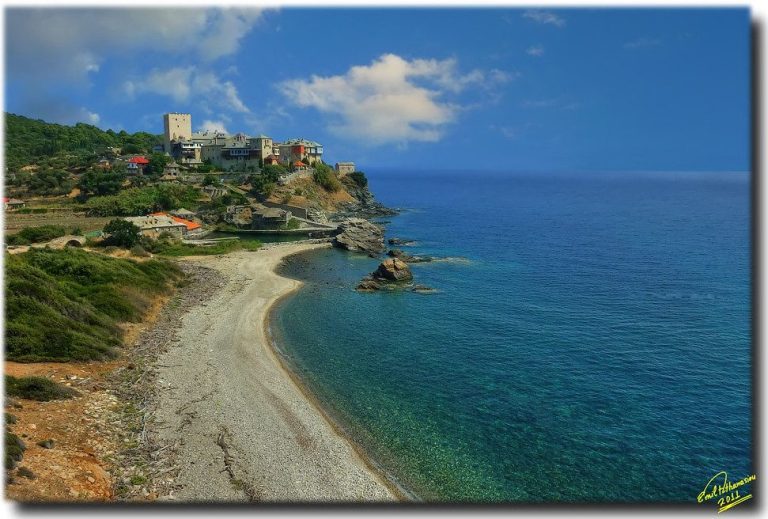
If you have ever passed the Monastery by boat even once, you immediately understand why it sticks in your memory. It’s large, bright, almost like a small town on the water, with the green domes standing out from afar.
From Ouranoupolis we often call it the “Russian monastery,” but in essence it’s a part of Mount Athos with a very particular history and atmosphere. If you’re planning a pilgrimage or just want to understand what you’re seeing from the boat, I’ll put things in order here, the way we explain them to our guests in the village.
The “Russian” Lighthouse of Mount Athos
Where it is and why it stands out
The Holy Monastery of Agios Panteleimon holds the 19th rank in the hierarchy of Athos’ monasteries. It’s built in a picturesque bay, between Xenophontos Monastery and the harbor of Daphne, in a spot that’s clearly visible from the sea on a clear day.
What makes it stand out isn’t just its size. It’s also its appearance, with the green, onion-shaped domes that recall Russian church architecture. In calm weather, especially in spring and early autumn, the water in the bay takes on that deep blue and the monastery looks even more imposing.
History and tradition, as you feel them on the Mountain
Russian monks have been present on Mount Athos since very early times, going back to the 11th century. They first settled in the Monastery of the “Carpenter,” and in 1169 they were granted the Monastery of the Thessalonian, today’s Palaimonastiro.
The current seaside monastery began construction in 1765. In the 19th century, with support from the Tsars, it flourished. In the early 20th century it’s said to have exceeded 1,000 monks, which explains its almost “urban” scale. You feel that in the buildings, the courtyards, the corridors—throughout how the complex is laid out.
If you want a solid, official starting point for the general framework of Mount Athos, it’s worth a look at Wikipedia for the geography and status of the area: https://el.wikipedia.org/wiki/Άγιο_Όρος. Don’t expect it to give you the feel of a visit, but it helps understand the structure and rules.
Architecture and sacred exhibits
The monastery’s Katholikon is dedicated to Saint Panteleimon and was built between 1812 and 1821. Its foundation is Athonite in style, but Russian influences are strongly visible, especially in the interior decoration and liturgical vessels. Even if you’ve seen other monasteries on Athos, here you’ll say, “this is something different.”
- Bell tower: It houses one of the largest bells in the world, weighing 13 tons.
- Holy relics: The skull of Saint Panteleimon is kept here, along with relics of Saint Silouan the Athonite and a fragment of the True Cross.
- Icons: The miraculous icon of the Virgin “Ierosolymitissa.”
As a practical tip, when you enter spaces with exhibits and relics, give yourself time. Don’t treat it like a quick stop. Better fewer things seen quietly than rushing from point to point. And yes, sometimes you’ll be struck by awe—that’s natural.
The library, a small treasure
The library is housed in a separate building and is considered one of the richest on Mount Athos. It’s not just shelves of old books. It’s memory, language, writing, and a continuity of centuries preserved through difficult times.
- More than 1,300 Greek manuscripts.
- 600 Slavic manuscripts.
- Over 20,000 printed books in Greek and Russian.
If you’re interested in these pieces of the Mountain, keep in mind that access and what you’re allowed to see can change by season. Not out of caprice, but for protection. Ask politely and patiently, and usually you’ll be guided.
Feasts and the calendar, so you don’t get confused
Important: The Monastery follows the Julian Calendar (Old), which is 13 days behind the civil (New) calendar. Practically, that means dates you hear “on the Mountain” may look different compared with your phone.
The main feast is Saint Panteleimon’s on July 27, which corresponds to August 9 in the New Calendar. Around those days activity can increase, and trip planning requires more care, especially if you’re coming from afar.
How to visit, without stress
The main advice I always give is to start from Ouranoupolis with enough time. Not rushing, not “I’ll make it.” Mount Athos requires a calmer pace. Your entry permit (diamonitirio) should be arranged months in advance, especially in high demand seasons. For official matters, always check updates from the competent authorities, because procedures can change.
For an official overview of the area and access, you can also check the Municipality of Aristotle (Dimos Aristoteli), which administratively covers the Ouranoupolis area: https://www.dimosaristoteli.gr/. It’s not a pilgrimage guide, but it’s a good source for practical information and occasional announcements affecting us.
Visiting procedure
In simple terms, the process goes like this:
First, the entry permit (diamonitirio). Without it you cannot enter Mount Athos, no matter how willing you are. Then travel is by boat from Ouranoupolis. Agios Panteleimon Monastery is the third stop after Docheiariou Monastery and Xenophontos Monastery, so on the boat you’ll have a little time to prepare and to study the coastline.
What to expect weather-wise. Mornings are usually calmer, with clearer air and better visibility. Afternoons can pick up a breeze, especially if the weather “turns” at sea. If you’re sensitive to motion, a simple motion-sickness pill and paying attention to your breakfast will help. Don’t overdo the coffee, I say that as friendly advice.
For the wider area’s weather, a reliable source is the Hellenic National Meteorological Service (EMY). Always check close to departure, because conditions at sea change quickly: https://www.emy.gr/.
When it’s best, by season
Spring is one of the most beautiful periods. Green, clear air, coolness. Summer brings more people, both in Ouranoupolis and on the boats. The water is clear, but the heat can tire you during transfers, especially if you have a backpack and walking to do. Autumn, especially September, is mild—less crowds, still good sea days, and a quieter pace.
Winter is a different story. More authentic for some, more demanding for others. It requires experience, proper clothing, and greater flexibility because weather can cancel routes. Better not to go in blind if it’s your first time, okay?
Who this visit suits
For pilgrims, it’s a powerful experience with a strong historical and spiritual imprint. For those who love architecture, you’ll see a mix of Athonite forms and Russian aesthetics that you don’t easily find elsewhere in Greece. For photographers, even if you don’t enter the Mountain, the view from the boat is among the most characteristic of Athos.
If you travel with family, remember Mount Athos has specific access rules. Many families choose a coastal cruise from Ouranoupolis to see the monasteries from the sea, then spend time on the local beaches and walks. It’s an honest solution without forcing situations.
Accommodation in Ouranoupolis, to be close to everything
If you want to do it right, base yourself in Ouranoupolis. Here is the harbor, here is the Pilgrims’ Office, and departures are organized from here. At Athos Guest House – Pansion we are a 5-minute walk from the Pilgrims’ Office, and in practice that solves a lot for you. You wake up, get a coffee, walk calmly, and don’t look for parking at the last minute.
We also offer luggage storage while you’re on the Mountain, which helps a lot. You don’t need to carry unnecessary items or worry about suitcases. And if you come by car, we’ll tell you what to expect regarding parking depending on the season—because in August it’s hectic in the village, to be honest.
Contact us for 2026 offers and family/group discounts.
If you like, tell us the dates you’re thinking of traveling and whether it’s your first time on Mount Athos. We’ll give you practical advice on how to move in Ouranoupolis, what to bring, and how not to waste time unnecessarily.
Contact us
to see the availability or offers for your stay.
send us an email to info@pansionathos.gr
call us: +306957638384 or +302377071337
call us or send a message via WhatsApp
send an SMS text message
call us or text us on Viber
Don’t forget to mention:
- Number of Persons, Possible Dates, Requirements
Useful phone numbers and small practical details
So you don’t search at the last minute, keep these basics. I always suggest confirming before travel, because details change, especially in bad weather or peak periods.
Holy Monastery of Agios Panteleimon: +30 23770 23252
Pilgrims’ Office (Thessaloniki): +30 2310 252578
Athos Guest House – Pansion: +30 23770 71337, +306957638384
Ouranoupolis Port Authority: +30 23770 71248
A realistic 4-day pilgrimage
If you want a flow that works well for most, without exhausting rushes, this is a scenario we often see. The key is to leave some buffer for delays and rest.
Day 1: Arrival in Ouranoupolis, check-in, a walk in the village and an early night. If you have time, sit for fish or a simple home-cooked meal. Don’t overload—get up early the next day.
Day 2: Departure for Agios Panteleimon Monastery. If possible, stay overnight there or at nearby Xenophontos Monastery, depending on the schedule and availability they give you.
Day 3: Transfer to Karya and then to Vatopedi Monastery, if that fits your pilgrimage plan. This requires good coordination and respect for each monastery’s schedules.
Day 4: Return to Ouranoupolis. A shower, a quiet meal, and an overnight before departure. Many underestimate this and go straight to Thessaloniki exhausted. Better to take it humanely.
If you want the official tourist picture of Central Macedonia, it has useful information on access and general regional details: https://www.visitgreece.gr/. We live it here every day, but it’s good to have an official source for general topics.
When you’re ready, book your entry permit properly first and then organize your base in Ouranoupolis. We’ll find the rest step by step, without pressure and without unnecessary promises. And if something doesn’t work in your schedule, don’t worry—on the Mountain there’s always another route, it just takes time and patience.
Contact us for 2026 offers and family/group discounts.